

No. A Wi-Fi camera or video doorbell sends its video over the air to your router, and a cheap radio jammer can drown that signal out, so the camera drops offline just when it’s needed. For CCTV, Nova only installs hardwired IP cameras: one network cable carries both power and video to a recorder inside the building, so there’s no radio link between camera and recorder for a jammer to block.
See it happen
This video, posted on Instagram by @aria.ethicalhacker in September 2026, shows a small home-made board (a “$10 ESP32 board”, the caption says) being switched on beside a garden camera and a video doorbell. Within seconds, the live view in the phone app stops loading. The post’s caption sums it up: “Backyard cam: OFFLINE. Doorbell cam: OFFLINE.”
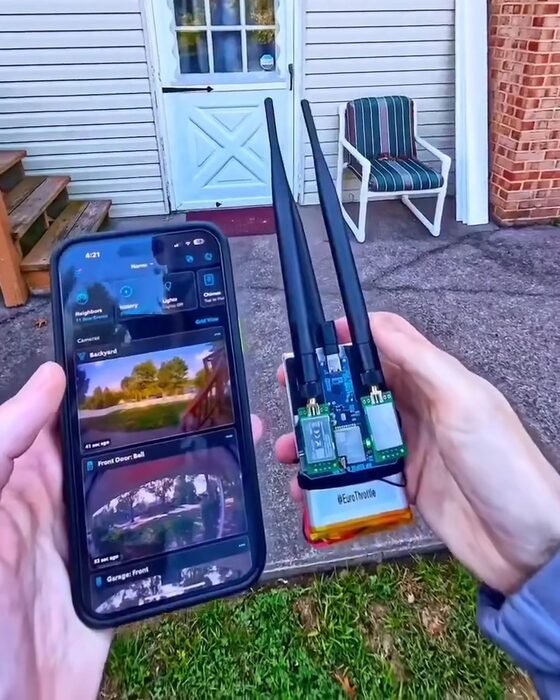
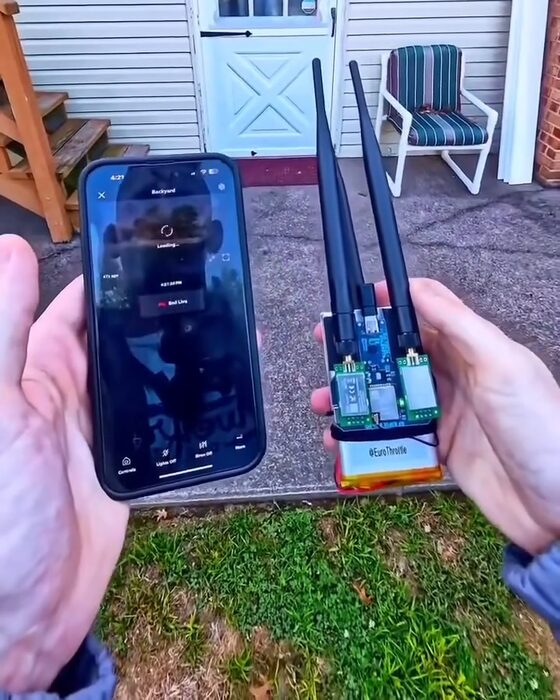
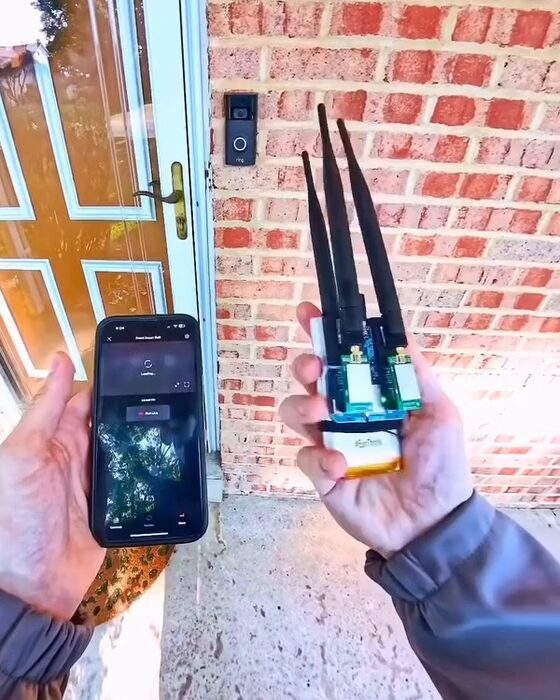
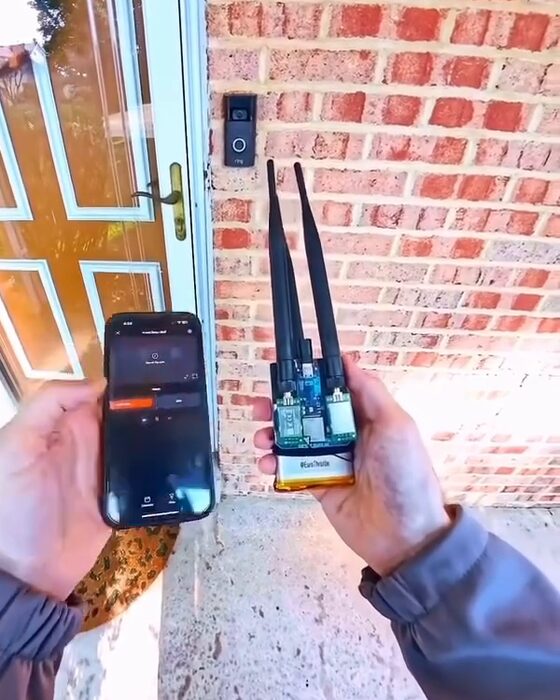
Stills from a video by @aria.ethicalhacker on Instagram. The post says the test was done on the creator’s own cameras, and that jamming other people’s is illegal.
Why Wi-Fi is the weak link
A Wi-Fi camera has to send everything it sees by radio to your router before it can be recorded or reach your phone. A jammer doesn’t need your Wi-Fi password: it simply fills the airwaves with noise so the camera and router can’t hear each other. It doesn’t matter how good the picture is, or whether the camera is battery or mains powered: if the radio link goes, the camera goes with it.
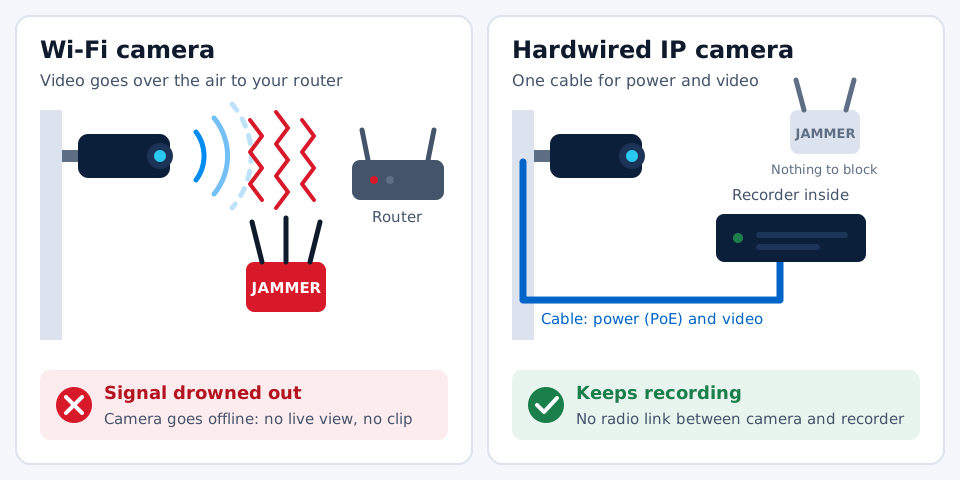
A hardwired IP camera works differently. One network cable carries both the power and the video (this is called Power over Ethernet, or PoE) to a recorder inside the building. There’s no radio link between the camera and the recorder, so there’s nothing for a jammer to block.
This isn’t just a video: police have warned about it
- Los Angeles, March 2024: the Los Angeles Police Department warned residents in its Wilshire area that a group of burglars was using Wi-Fi jammers to disable Wi-Fi cameras and alarms, and recommended hardwiring alarm systems.
- Glendale, California, March 2024: Glendale police warned of burglars using Wi-Fi jammers to knock out alarms and cameras. A police sergeant told ABC7 the device “blocks the signal and knocks it out”. Their first piece of advice: use wired connections for alarm systems and cameras.
Those warnings came from the United States, but the technology is the same here: Wi-Fi cameras and video doorbells sold in the UK use the same Wi-Fi bands.
What about video doorbells?
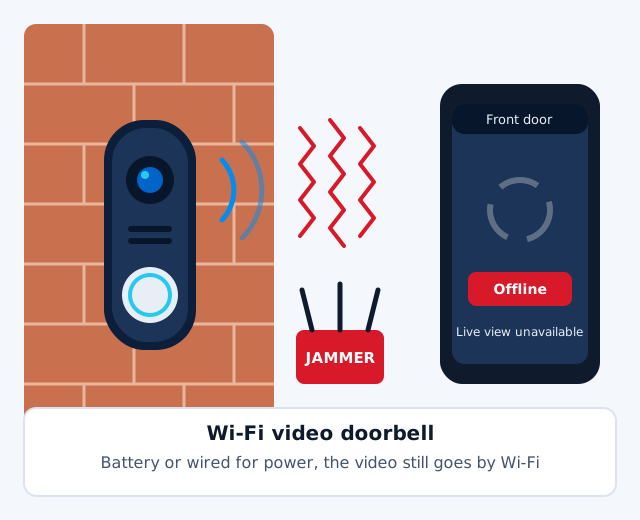
Most video doorbells, Ring’s included, send their video over Wi-Fi, even when they’re wired in for power. So the same weakness applies, as the video above shows. Ring does make a doorbell with an Ethernet port, the Wired Doorbell 4K Elite, but Ring’s own specification says its cable “may be used for power only, with wifi for connectivity”.
If you want to see and speak to visitors, a video intercom cabled to your network is the sturdier choice.
Isn’t jamming illegal?
Yes. In the UK it’s a criminal offence to use any apparatus to interfere with wireless communications, under section 68 of the Wireless Telegraphy Act 2006, and supplying non-compliant equipment is an offence too. Ofcom says it doesn’t authorise or licence the use of jammers.
But the law won’t protect your cameras. Someone breaking into a building isn’t deterred by one more offence, and in April 2026 the government said the law “does not currently prohibit possession of a radiofrequency jammer specifically”, as it asked for views on whether it should.
What we install instead
- Hardwired IP cameras, with one network cable for power and video
- A recorder inside the building, so footage is kept on site even if the internet connection goes down
- Cables run out of reach and inside the building wherever we can
- Outbuildings and gates a cable can’t reach joined to the main building with a dedicated point-to-point wireless link, with the cameras there still cabled. It’s still a radio link, so we only use one where cabling isn’t practical
- Alerts if a camera stops sending video, so you know straight away if one is cut, covered or fails
- Analytics that tell a person or vehicle from a moving tree, so the alerts on your phone mean something
- Camera views designed in NOVA System Designer, so you see the coverage before we drill a hole
No security system is impossible to beat: a cable can be cut or a camera damaged. The difference is that a wired camera can’t be silenced from the street by someone who never touches it, and if it is attacked, it’s on camera and you get an alert.
What about Nova’s wireless alarms?
We do install wireless intruder alarms from Ajax, and they’re a different technology. Ajax detectors don’t use Wi-Fi: they talk to the hub on Ajax’s own Jeweller radio. Ajax says the hub constantly measures the noise on its radio channel, detects jamming when the noise stays above −70 dBm for 30 seconds, switches to a less noisy frequency and sends a jamming notification to the users and the security company. It also raises an alert if a detector stops communicating. So jamming an Ajax alarm doesn’t go unnoticed: it tells you and your monitoring centre.
Already have Wi-Fi cameras?
- Turn on the app’s offline or connection alerts, so you know when a camera drops off
- Work out which cameras matter most, such as the front door, driveway or rear access, and get those cabled first
- Ask us for a free survey: we’ll tell you honestly what’s worth keeping
Sources
- @aria.ethicalhacker on Instagram: the video shown above (22 September 2026)
- Sacramento Bee via Yahoo News: Thieves are using Wi-Fi jammers to break into people’s homes, California cops warn (5 March 2024)
- ABC7: Glendale police issue warning about burglars using WiFi jammers (21 March 2024)
- Ofcom: Rules on using radio equipment
- GOV.UK: Possession of radiofrequency jammers and the relevant legal framework (call for evidence, 10 April 2026)
- Wireless Telegraphy Act 2006, section 68
- Ring: Wired Doorbell 4K Elite specifications
- Ajax Systems: What is jamming
This information is general guidance, not advice for any particular building, and standards and guidance change. Get advice from a competent person for your premises. See our website terms and disclaimer.